How to Make Money with Digital Twins in the Process Industry
2026-03-20
CEO's perspective
Jay Yun, CEO
Digital twins have been one of the most frequently discussed technologies in industry over the past few years.
However, the most common question I still hear from plant operators is this:
“So, do digital twins actually make money?”
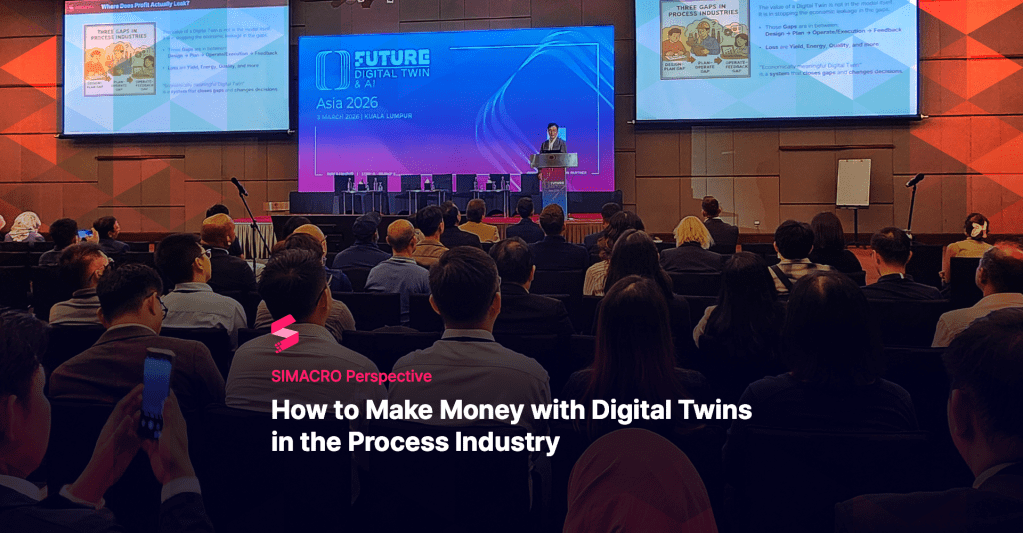
I recently addressed this very question during my presentation at Future Digital Twin & AI Asia 2026 in Kuala Lumpur, Malaysia.
And to state the conclusion upfront:
Digital twins do not make money through models. Money is created when you reduce the “gap.”
1. Where does operational margin disappear in manufacturing?
Process and asset designs are usually highly optimized.
The real problem is not the design itself, but the small deviations that occur during operations.
Operational losses occur between the following stages:
Design Intent ↔ Actual Execution Actual Execution ↔ Feedback
There is always a “gap” between design intent and real-world operations.
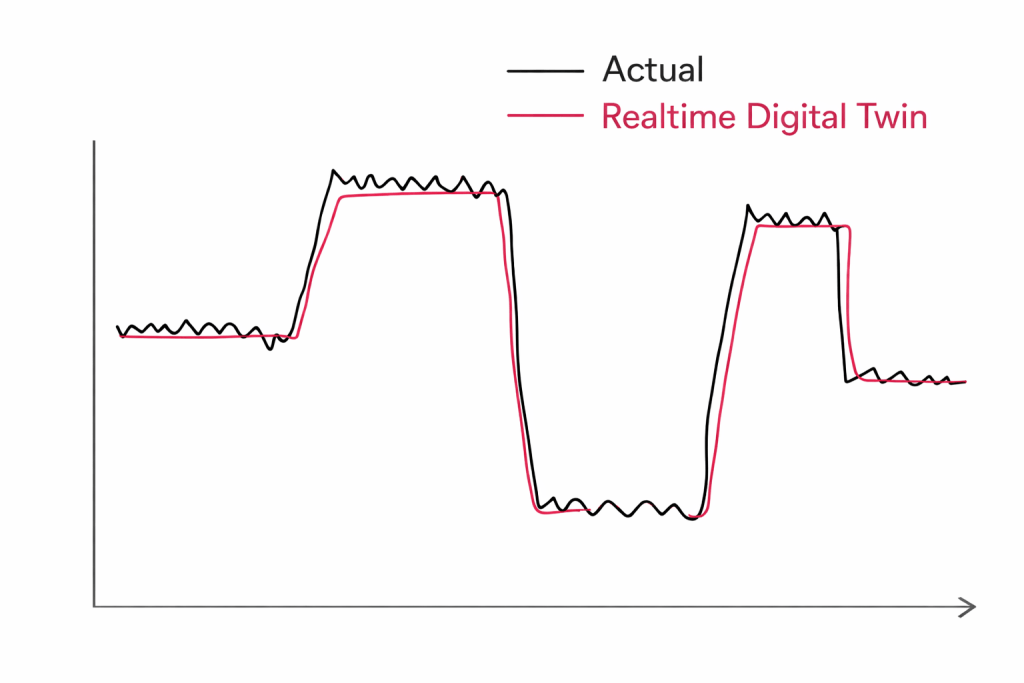
The "gap" between plan and actual operations — every deviation from design intent represents a loss in yield, energy, or quality.
Over time, these small gaps accumulate and lead to losses such as:
Reduced yield
Energy waste
Quality variation
Operational instability
In other words, plant profitability leaks out through these operational gaps.
It is important to understand this distinction:
An economically meaningful digital twin is not a model that replicates the process. It is a system that reduces operational gaps.
A truly valuable digital twin does not simply visualize data.
Instead, it:
Continuously synchronizes models with real process data
Allows operators to validate decisions through what-if simulations
Reduces the time between execution and feedback
As this cycle repeats, the quality of operational decisions improves, and profits accumulate over time.
A real-time digital twin continuously tracks actual operations, narrowing the gap and reducing accumulated losses.
2. Where should a digital twin start?
Many companies begin digital twin initiatives with the goal of digitizing the entire plant.
However, the projects that actually generate ROI typically start from much simpler and more focused areas.
I call this the 3C Rule:
Costly – A problem where the economic loss is clearly visible.
Controllable – A problem where operators have levers they can adjust.
Continuous – A problem where decisions must be made repeatedly.
When digital twin initiatives start in areas that meet these three criteria, their value grows compounding over time.
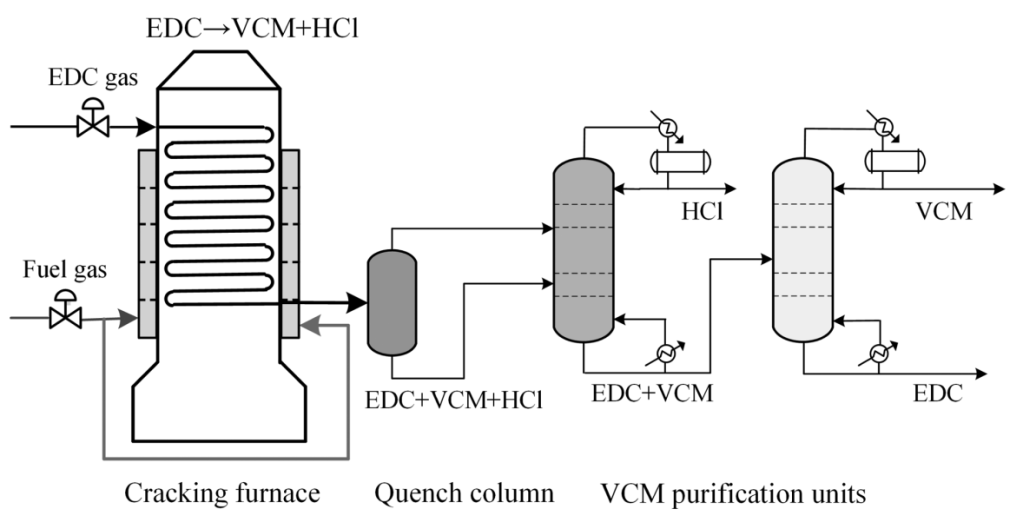
EDC cracking and VCM purification process — a real-world example of where the 3C Rule (Costly, Controllable, Continuous) applies.
3. Why could AI be risky in Process Operations?
There is another critical issue to consider.
Many organizations attempt to connect AI directly to plant systems.
However, in high-risk industries like the process industry, 90% accuracy is not enough.
A single incorrect decision can result in:
Safety incidents
Equipment damage
Off-spec production
4. What is a Digital Handle necessary?
To ensure reliability, an intermediate validation layer is required between AI and the plant.
I call this the “Digital Handle.”
This layer performs several key functions:
Collecting process data
Comparing models with real plant conditions
Validating AI decisions
Running simulation tests
AI should then be introduced gradually, in stages:
Monitor → Recommend → Simulate → Automate
This is similar to why autonomous vehicles still have a steering wheel.
“Would you feel comfortable purchasing a fully autonomous car without a steering wheel?”
For industrial autonomy, AI and digital twins must be staged and validated.
Intelligence without validation cannot earn trust in industrial environments.
The "Digital Handle" architecture — a safe OT/IT bridge connecting plant data to AI through validation layers.
5. What should the real role of Digital Twins be?
Many people think of digital twins as:
Dashboards
Visualization platforms
Data analytics systems
But in the process industry, the role of a digital twin is very different.
A digital twin is:
A system for designing autonomous operations
A platform for testing operational strategies
A safe environment for gradually evolving industrial intelligence
For Industrial AI to succeed, two principles are essential:
AI must respect physical models Physics must constrain AI.
AI must be introduced gradually Intelligence must be staged.
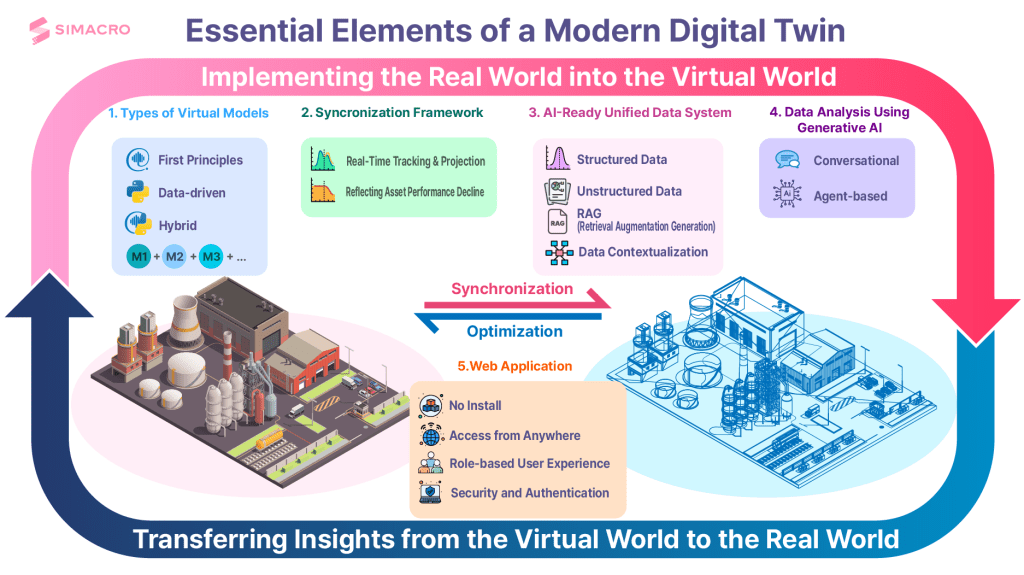
Essential elements of a modern digital twin: physics-based models, synchronization framework, AI-ready data, generative AI analysis, and web application.
6. Summary
The purpose of digital twins in the process industry is not to replicate the plant.
The purpose is simple: To close the “gap” where profit leaks out.
As the gap narrows:
Yield increases
Energy consumption decreases
Operational stability improves
At that point, the digital twin becomes more than just a technology.
It becomes a system that continuously improves the economics of the plant.
Final thought
Close the Gap. 2. Guard the Intelligence.
These two principles define how digital twins truly generate economic value in the process industry.